
您好,我是小DAI,专注于数据库管理员相关的技术问答,请问有什么可以帮您?
ad_sql__left__join
SQL LEFT JOIN 语法
SELECT column_name(s)
FROM table1
LEFT JOIN table2
ON table1.column_name=table2.column_name;或:
SELECT column_name(s)
FROM table1
LEFT OUTER JOIN table2
ON table1.column_name=table2.column_name;注释:在某些数据库中,LEFT JOIN 称为 LEFT OUTER JOIN。
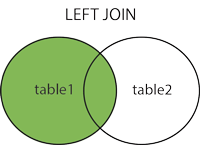
- table1:左表(主表),LEFT JOIN 会保留该表的所有记录。
- table2:右表(从表),如果没有匹配的数据,用 NULL 填充对应的列。
- ON table1.column_name=table2.column_name:指定连接条件,通常是两个表的共同字段。
特点:
- 返回左表中的所有记录,即使右表没有匹配的数据。
- 如果右表没有匹配的记录,结果中该行右表字段为 NULL。
假设有两个表:Customers 和 Orders。
Customers 表:
CustomerID Name 1 Alice 2 Bob 3 Charlie 4 David Orders 表:
OrderID CustomerID Product 101 1 Laptop 102 2 Smartphone 使用 LEFT JOIN 查询:
SELECT Customers.Name, Orders.Product FROM Customers LEFT JOIN Orders ON Customers.CustomerID = Orders.CustomerID;查询输出结果:
Name Product Alice Laptop Bob Smartphone Charlie NULL |David NULL
解释:LEFT JOIN 返回了 Customers 表中的所有记录。对于 Charlie 和 David,由于在 Orders 表中没有匹配的 CustomerID,它们对应的 Product 列为 NULL。
演示数据库
在本教程中,我们将使用 RUNOOB 样本数据库。
下面是选自 "Websites" 表的数据:
+----+--------------+---------------------------+-------+---------+ +----+--------------+---------------------------+-------+---------+ <table> <tr> <th>1</th> <th>Google</th> <th>https://www.google.cm/</th> <th>1</th> <th>USA</th> </tr> <tr> <td>3</td> <td>菜鸟教程</td> <td>http://www.runoob.com/</td> <td>4689</td> <td>CN</td> </tr> <tr> <td>4</td> <td>微博</td> <td>http://weibo.com/</td> <td>20</td> <td>CN</td> </tr> <tr> <td>5</td> <td>Facebook</td> <td>https://www.facebook.com/</td> <td>3</td> <td>USA</td> </tr> <tr> <td>7</td> <td>stackoverflow</td> <td>http://stackoverflow.com/</td> <td>0</td> <td>IND</td> </tr> </table> +----+---------------+---------------------------+-------+---------+下面是 "access_log" 网站访问记录表的数据:
mysql> SELECT * FROM access_log; +-----+---------+-------+------------+ +-----+---------+-------+------------+ <table> <tr> <th>1</th> <th>1</th> <th>45</th> <th>2016-05-10</th> </tr> <tr> <td>3</td> <td>1</td> <td>230</td> <td>2016-05-14</td> </tr> <tr> <td>4</td> <td>2</td> <td>10</td> <td>2016-05-14</td> </tr> <tr> <td>5</td> <td>5</td> <td>205</td> <td>2016-05-14</td> </tr> <tr> <td>6</td> <td>4</td> <td>13</td> <td>2016-05-15</td> </tr> <tr> <td>7</td> <td>3</td> <td>220</td> <td>2016-05-15</td> </tr> <tr> <td>8</td> <td>5</td> <td>545</td> <td>2016-05-16</td> </tr> <tr> <td>9</td> <td>3</td> <td>201</td> <td>2016-05-17</td> </tr> </table> +-----+---------+-------+------------+ 9 rows in set (0.00 sec)SQL LEFT JOIN 实例
下面的 SQL 语句将返回所有网站及他们的访问量(如果有的话)。
以下实例中我们把 Websites 作为左表,access_log 作为右表:
实例
SELECT Websites.name, access_log.count, access_log.date FROM Websites LEFT JOIN access_log ON Websites.id=access_log.site_id ORDER BY access_log.count DESC;执行以上 SQL 输出结果如下:
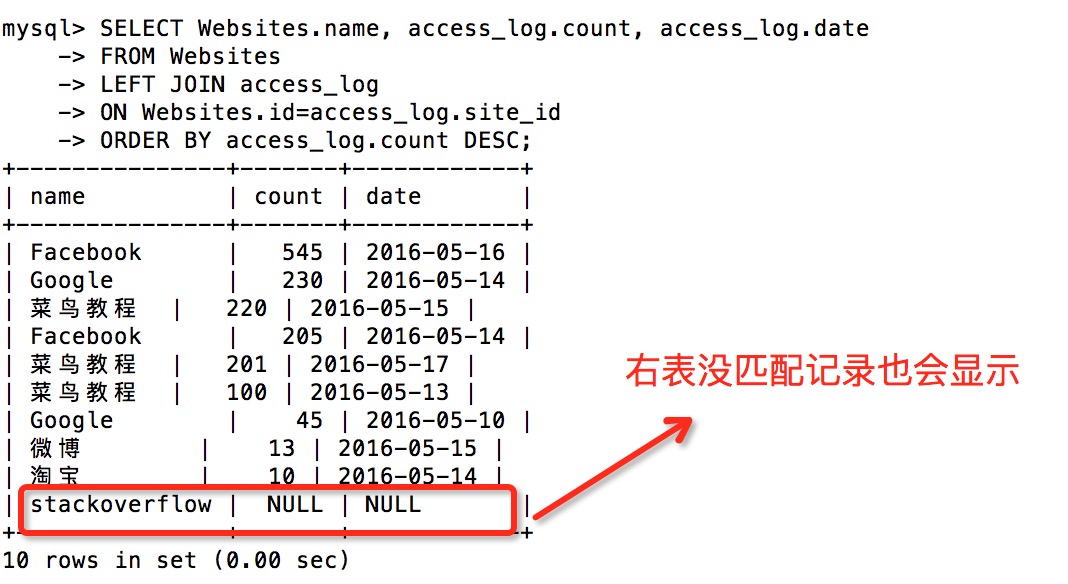
注释:LEFT JOIN 关键字从左表(Websites)返回所有的行,即使右表(access_log)中没有匹配。
来源:https://www.runoob.com/sql/sql-join-left.html